Tuesday, March 29, 2011

a day in the life

I don’t think I’ve ever explained what a typical day is like for me here in Morocco, so here it is.
SIT’s Morocco Program partners with a Moroccan organization of academics at the Center for Cross-Cultural Learning, which was founded 15 years ago (as of this Thursday) by one of my Academic Directors and his wife. We have one contact person at CCCL who helps us with any daily problems, then two Academic Directors who are university professors and who teach our classes.

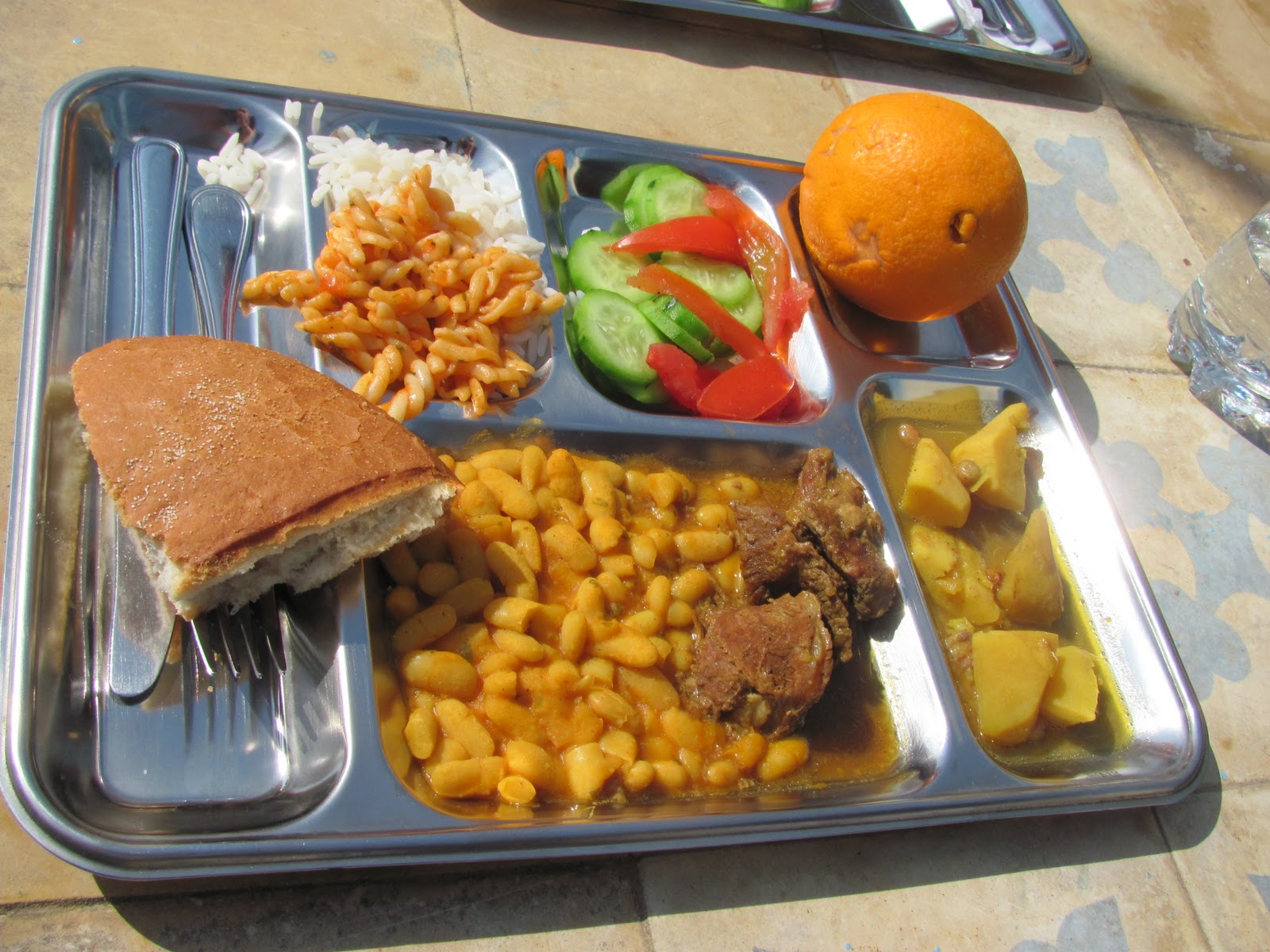
Currently the CCCL has three buildings, two inside the medina and one next to the medina. Each building is a converted house or apartment building. One is the library, which has lots of classrooms and offices and a modest but pretty quality selection of books. The building outside the medina is hosts Arabic classes, which is where I take my Fusha and Darija classes every morning. The main building of CCCL is also in the medina, very close to my house. It is a 17th century Andalusian house in the traditional style, with an open courtyard (now covered) and two terraces. There is also tile covering almost every surface. The lowest level is where public lectures are held, in the open area, and on the second level there are classrooms where daily lectures are held. The third level is the cafeteria. Everyday Brahim, the head chef, and the cooks make lunch for everyone. If we are at CCCL around tea time for any reason, Brahim will make tea and treats for us as well.

7:15 am- wake up. I share a room with my two host sisters so I try to be as quiet as possible, but my armoire has a very squeaky door that has caused some annoyance on multiple occasions! Zineb, my host sister  makes tea for us and we have a breakfast of tea and bread (or sometimes raif; Moroccan crepe) with honey or olive oil. Then she goes to school at 8 and I leave for Marassa, the Arabic annex. I live right off the produce market, “Rue Boukroun”, and every morning I meet Olivia, who also lives off Boukron, and we walk together down the market to school. 8 is the time all the sellers come out to start setting up shop. Fish are being cleaned and filleted, the chicken truck is arriving with a new batch of hens (they are slaughtered right there in the shop), bouquets of herbs are being assembled, and fruits and vegetables are being arranged. And of course the cats are out trying to steal some stray food. It might sound cute, but it actually smells really bad. There are also stores that sell toiletries, candy, nutella, and bottled water.

8:30-12:00- Fusha Arabic at Marassa, the CCCL’s annex outside the medina. There are 4 people in my class including me, so we are able to get lots of individual attention. Today Tammam instituted the rule that we are only allowed to speak in Fusha, and each time we speak another language we have to put one dirham in a cup, like a swear jar.

12:00-1:00- Lunch break! It’s about a 10-15 minute walk to the CCCL where the cafeteria is located.

1:15- Themed Seminars, which change each week and are taught by a different guest professor or our academic director. Lectures last anywhere from 1 ½ to 3 ½ hours depending on the teacher. The first week was about Western Sahara, the second week was about Authoritarianism in Morocco, and after that we got to choose between three options. Last week I chose the religion module and this week I chose the women society and change module, which have overlapping and complementary themes.

After class we usually have free time for the rest of the evening. Sometimes we have extra classes or public lectures until 6 pm. Right now my internet needs to be renewed, so I will stay after today to check emails, facebook, etc. Then I go home for tea time at 5 or 6. Boukroun is still bustling at this time, and all the shopkeepers are getting out tea to share with each other (mint tea is the national drink of Morocco). We usually have bread and tea (sometimes raif and cookies as well) for tea time, and some family members from downstairs come up to have a break as well. Afterward, everyone resumes their daily activities. It is Moroccan tradition to not linger after a meal, so every eats until they are done with their conversation, then they pretty much leave immediately. I usually go to my shared bedroom and do homework. Here and the terrace are the only places my family really allows me to do homework, so many times I end up doing homework at Olivia’s house, who has a very warm and welcoming family, and her mom has fed me many times!

I don’t have a curfew now that I can find my way around the medina, but after 9 it’s not a good idea to walk around the medina alone as a woman, so I try to be home by then unless I have a someone to walk me home (usually Olivia’s host brother Karim). We eat dinner sometime between 9:15 and 11:00, then pretty much immediately everyone goes to bed. I have to be done with homework by this time because there is nowhere for me to do it besides my bedroom. Then I go to sleep and start again the next day! 

Sunday, March 6, 2011

My Dowry is 5 Camel and a Goat

I went to the protests in front of Parliament on February 20 in Rabat with Toure, Arielle, Song, and Olivia, but if you saw any violence surrounding the protests on TV, it most definitely was not in Rabat. Basically it was like a block party. People were holding signs and stuff against the government, but there were performance artists, people selling candy, and friendly crowds hanging out. The crowd was big enough to block off the streets in front of Parliament, maybe 1000 people. There were police in the area but they weren’t armed, which is significant for two reasons. The first is that 15 years ago this would not have been possible here. The people would have been beaten by violent and corrupt armed security. But now, even though it was in front of an important government building, the police were unarmed and giving the crowd enough space. King Mohammad VI has made important progress in free speech, and allowing the people to protest is a major aspect of free speech. Even though Morocco’s government is set up to disadvantage the majority in terms of political participation, these people feel in this moment like their voices are being heard. I don’t think this is a particularly sustainable way to pacify the masses, but it’s working right now. We talked last week about reforming government and whether authoritarian regimes can be reformed from within or if it’s necessary to reform externally (meaning revolution). In Libya, Egypt, and Tunisia the latter was necessary, but since the current king ascended to the throne here, he’s been attempting internal reformations in an effort to avoid a revolution in Morocco.

When we were there a few people wanted to take pictures with us at the protest because we looked really out of place among crowds of Moroccans. We were only there to observe and not to participate, but they were still excited. One guy came up to us to show us his vacation pictures in Jacksonville, Florida. We ended up getting him to explain to us the purpose of the protest. Mostly people are unhappy with the government and the Constitution, but no one wants to topple the monarchy.  There were people flying a Berber flag (which is the prettiest flag ever, btw) and also people flying Moroccan flags because everyone is unhappy for different reasons. Eventually it was lunchtime so we decided to leave the protests and go get some crepes.

Then on Feb. 24th I had my first bellydancing lesson! One of the other girl’s host sisters is a professional bellydancer so she is giving us lessons. It's so fun! I also want to start surfing lessons, but I haven't yet because the timing hasn't been right, but I do go to the beach all the time and watch the waves crash against the breakers (the beach is only two minutes from my house).

Southern Excursion

On Friday the 25th we left on our Southern Excursion. The first day we drove through the biggest Atlas Cedar Forest in the world. In this forest there are barbary macaques, whose only predator (the lion) was hunted to extinction in this area a long time ago, so their population has exploded! We saw some hanging out near where our bus was stopped so we took pictures with them. I went right up to one, sat down next to it and took a picture. It was awesome. And I didn’t even get rabies! So then we drove to the desert (think Arizona) and stayed the night in a hotel where we had live music, which we had at pretty much every meal on this trip. Saturday we drove to Rissani, a town near the Merzouga Dunes, and switched to Land Rovers because our hotel wasn't close to any paved roads. When we got to the dunes we visited and NGO that helps women with literacy and also helps them earn money for their families if they've been divorced or widowed. We also visited an irrigation system for date palm groves that doubles as a freshwater service to the entire community.

Then the highlight of the entire trip: we rode camels! My camel was pure white and really tall and I did in fact name him Jorge. We took the camels out to the middle of the dunes and watched the sunset, then we came back for dinner. I fell asleep in the lounge after dinner, and when I woke up there was a performance of Gnawan music. Gnawan music was the music of Berber slaves back in the day when they were being transported from the south to the north. Some teachers and students were hanging out but most of them were gone. Two of the teachers grabbed some instruments lying around and started to play with them. There was another drum not being used so I grabbed it and started playing with them. The rest of the girls in the room started dancing! After the performers taught us a traditional dance. After they were done I wasn't ready to go to bed so I went outside and sat on the dunes and looked at the stars. There was zero light pollution except from this hotel (which wasn't very much) so I could see everything!! The Milky Way, other galaxies, all the constellations were bright in the sky (from a different angle of course). Then we happened upon some random Berber guys who worked at the hotel and we talked about the stars and our different names for them. Then one of them offers three camels for Alia's hand in marriage. When she said no, I accidentally agreed to marriage… whoops! I guess you should never shake hands with someone who is speaking a language you don’t understand. So I will be returning to the desert at the end of this trip for a little celebration ;)

The next morning we got up at 5 am and walked 40 minutes into the dunes to see the sunrise. It was beautiful! We could see a plateau in the distance and Lahcen, our professor on the trip, told us that on the other side was the border with Algeria, about 20 km away from where we were sitting. When we got back a breakfast buffet had been set out outside next to a small bonfire with a typical Moroccan breakfast of bread, butter, jam, honey, olive oil, croissants, and hard-boiled egg; and of course orange juice, hot chocolate, mint tea, and coffee. That day we left the desert and went to a town called Ouarzzazate, where a lot of movies are filmed (like The Mummy). That night we stayed at a girls’ dormitory called Dar Taliba (in Arabic, “Students’ House”). Dar Taliba allows rural girls to attend vocational schools and universities in urban areas. For $150 they live there year-round and are fed. After dinner the girls taught us more dances using only a tambourine and their voices. We danced for an hour and then the girls wanted to learn an American traditional dance. After careful consideration we decided on the Cha Cha Slide (imagine trying to recreate that with only a tambourine). They were so excited! Finally I snuck off to bed, but I could still hear them playing and dancing until 11:30.

On Monday we went to Marrakech and had two free days in the city. The first night I went to a sushi restaurant called Katsura with some friends, and after we hit up the Moroccan club scene, which consisted of a nearly empty dance floor except for a few creepy men (what else is new in Morocco) and awful techno music. We also visited Djemma el Fna, the main market in the medina of Marrakech. There were people competing to make the best food, storytellers, acrobats, fortune tellers, henna artists, people with monkeys, and snake charmers who would run after you and try to throw their snake across your shoulders to force you to pay them! It was crowded, but probably more with tourists than with actual Moroccans.
On the last day we spent the night in Essaouira and ate sardines for lunch. Essaouira has a beautiful beach, but it’s too windy to enjoy it unless you want to get sandblasted, so instead we walked around the medina.

Also on this trip we crossed three mountain ranges, the Middle Atlas, the High Atlas, and the Anti (Ante?) Atlas. The mountain passes are called tizis, and they are way too windy and narrow for a bus to cross, but somehow we managed to cheat death several times. At one point Lahcen was anticipating such a difficult time that he bought Dramamine and passed it out to anyone who thought they might get motion sickness. On this tizi there were steep drop-offs on either side of the road and we could see 5 levels of hairpin turns on top of each other. It was scary but we made it out alive!

Poetry Slam

On Friday we went to a poetry slam put on by Olivia’s friend who is in Morocco doing a Watson Fellowship. She held workshops for university and high school students and this performance was their final product. Although English is most people’s 4th language, these women were able to express themselves through their spoken word better than I think I could. I was totally in awe. They talked about taboo subjects like the veil and sexual harassment. It was moving to hear personal testimonies about such a politically charged piece of cloth. At one point there were seven women on stage and each would step forward in turn and give a personal reason for either veiling or not veiling. The women that don’t felt like they were considered “loose” or unfaithful, and the women who did felt like it was protection against harassers, and a gesture of patriotism and also of  faith. They had been told when they were younger they would be more respected for wearing the veil, but all of them find that the reality is that job recruiters discriminate against women who veil even in an Islamic country. Some talked about patriotism as well, but what I found the most compelling was the women who spoke about sexual harassment. It doesn’t just happen to foreigners, and even though I’ve been having a really hard time (as well as fellow students) with it, I can’t imagine living with it my entire life. In Morocco, all public space is a man’s space, and even when they don’t actively harass women, they certainly make them feel unwelcome. And these girls stood up before a crowd of both men and women and spoke passionately against their harassers. That’s why at the end of the night when random men, young and old, from the crowd started to get up and speak in front of the microphone uninvited, I was infuriated. Even though their language was of “respect” and “admiration” towards women, their actions were undermining the hard work and courage of these women who had spent so much time preparing for this night and baring their feelings. They were turning what had been built up as a space of feminine power into their space, a man’s space. If they were really moved by this performance, they could have easily kept their mouths shut and changed their actions in daily life, but instead they decided to get up and take another thing away from these women, the pride of their accomplishments of the evening. And I don’t doubt it had something to do with American girls being in the audience, which was confirmed at the end when I saw one of these guys walk up to another student and ask for her information. And when these guys started standing up it wasn’t even at the end of the show. There was one final performance that was supposed to include all of the women saying why they write, and they were all standing their while these guys came up one by one, just letting it happen. Finally another American student stood up and pointed out that the performance was about the women, not the men, and so they shouldn’t be up there. Then the show was able to resume and the girls performed their final act, but it made me wonder what had really been accomplished that night. Afterwards, we talked with the girls about their performances. They loved that we loved it, and also were excited to talk about the mythical land called “America"

Monday, February 21, 2011

Week of Eid!

Ok, so I haven't posted in awhile so I had a few posts to put up and I decided to break them in to a few parts. Here's the next one:

The week was less eventful. My family doesn’t have little kids, and Valentine’s Day isn’t as big here, but Wednesday and Thursday are a very special holiday: the Prophet’s birthday. On this day, neighbors visit one another and people visit those to whom they’ve done wrong during the past year to ask forgiveness visit. There is also lots of yummy food eating at all meals. For breakfast we had crepes, chocolate cake, cookies, honey pancakes, tea, and coffee. For lunch on Thursday we has Cous Cous! The whole family from downstairs plus a neighbor ate with us, so we ate in the formal living room. They all tried to teach me how to eat cous cous with my hands. By the time we were done eating, my entire hand, pants, and the floor around me was covered in cous cous, but I had gotten it down pretty well. On Friday we ate a more modest meal because we’d eaten so much the day before. Mostly I was really sick so I stayed in bed for four days. 

First Excursion Madness! (2/12-2/14)

Two weekends ago was our first excursion! We visited sites of importance to Moroccan history: Meknes, Moulay Idriss, Volubilis, and Fez. Saturday morning we got up bright and early and met at the CCCL to load the buses. The Tunisia program went with us on our excursion and the Migration group went north to some beautiful coastal cities. As soon as we left Rabat, the scenery opened up into lush green rolling hills. We passed some areas of farmland, pastures with horses, sheep, and cattle, and some slightly more mountainous areas (more hilly than mountainy). Even though it was a major highway, I definitely saw cattle about to roam into the road at one point.
We had a bathroom break halfway through where I decided to order some tea hoping I could get it to-go. This was a very popular decision in the group, and unfortunately we all realized too late that there is no “to-go” when it comes to hot drinks, even at a gas station. Tea is served in a glass and coffee is served in a porcelain cup. So it ended up taking a lot longer than our leaders wanted to take that break. I also ordered msmen (which I’ve also seen called raif), which is like a Moroccan crepe. It doesn’t really have anything in it, so actually it’s just a thin fried pancake. So, eventually we got back on the road and made it to Meknes, where we met our first guide. He was a short Berber guy (I’m assuming, because he kept making jabs at Arabs) dressed in traditional clothing. This guy was SO ready to tell us why Meknes is the BIGGEST, BEST, and (insert superlative here) place in Morocco.
            Meknes, while maybe not the most interesting place, has a rich history. Located here is the palace of Moulay Ismael, a grand Moroccan king who built (what our guide called) the largest palace in Africa ever. It is no longer inhabited, but stands as a historical marker. Meknes is still the only major Moroccan city where King Mohammad VI doesn’t have a palace. We saw one of the 10 most beautiful gates in the world there also. It was very large with intricate designs, and our giant bus was only allowed to park there for a few minutes so we could get off and take pictures, because we were most definitely blocking traffic. So we continued through successive gates to the city, each revealing a different historical quarter. The palace of Moulay Ismael lies at the center of the city, and there are 3 walls in concentric circles around it, each where a different quarter was located. We visited the old chellah, or Jewish quarter, which is not really known for a Jewish population since most Moroccan Jews went to Israel in the 1950’s. Finally we went through the center gate and we got to see part of the ruins of the palace. It was beautiful, but unfortunately it had been partially destroyed by the Lisbon earthquake of 1755. As we were going into the inner gate, our guide pointed out the building where the first treaty to recognize the United States of America was signed. Then we went to the granary for the horses of Moulay Ismael. It was a huge granary that could store enough grain to feed his 12,000 horses for 3 years! Half of the granary was built with arched ceilings, but it took too long and Moulay Ismael ordered the builders to begin using flat roofs. They were the ones that would fall victim to the earthquake, but the arched ceilings remain intact. Moulay Ismael was a grand king, similar to his French counterpart, Louis XIV. The story is that Moulay Ismael wanted his son to marry the French king’s daughter, so he built his own gardens similar to those of Versailles. Still, the marriage didn’t work out. His main contribution to Moroccan history is that he was able to prevent the Ottomans from taking the region. In Meknes we also visited the tomb of Moulay Ismael, who I think is also one of the first Alawite kings, which is the current dynasty ruling Morocco.
            The last place we went to was an artisan shop where we were shown a special art form using metal and silver thread. This is only practiced in two places in the world, here and Toledo, Spain. It was cool, but of course our guide took us there because he gets a commission from what we buy.
            The next destination was Moulay Idriss, a beautiful little town nestled in the mountains and covered in olive trees (seriously, everywhere). Moulay Idriss is named for the first Islamic dynasty to come to Morocco and the first person to consolidate the kingdom of Morocco. After a very precarious drive on some winding, narrow mountain roads, we made it to our lunch destination, a family restaurant in the hills of Moulay Idriss. We were served tajine with chicken and quince (so delicious), and for dessert, almond-stuffed dates. Then we took a short drive to Volubilis.
            Volubilis is on the outskirts of the town, and represents the southernmost city of the Roman Empire. It was destroyed in the Lisbon Earthquake, but after extensive excavations, some of the ruins have been reconstructed. This is an ongoing project. Here we had a wonderful and knowledgeable guide who told us the story of the town. We were able to see the temple of Jupiter, some individual homes with intricate mosaics, public bathrooms, a hot tub, the public speaking arena, and even a brothel. The Colosseum hasn’t been uncovered yet, but archaeologists have an idea of where it should be and hope to uncover it in the future.
            After Volubilis we pushed on to Fez, where we arrived at an amazing hotel called Hotel Batha, only a few minutes walk from the main gate of the famous medina. There was enough time to shower and enjoy the heated rooms (this is the first time we’ve experienced this since being here) before we met for dinner. We went to a nice restaurant that served kebabs and an egg and meatball concoction. For dessert, we of course had fruit (standard here): bananas, oranges, and a special treat, strawberries! There was also live traditional music.
            The next morning we started on a crazy tour of the city. First we visited places outside the medina, including one of the king’s palaces. Just the door knocker was bigger than my head! Then we went to a lookout above the city to get an idea of the size of the medina. It is the biggest in the world and has been declared a world heritage site by the United Nations. There are over 60 miles of streets in the medina, and some of these are barely wide enough for one person to walk through facing forward. The only means of transport inside the medina is on foot or by donkey, and pack animals are also used to transport goods. The problem is that when these animals get loaded down with goods on either side, they become
a)     as wide as the entire street
b)    unstoppable until their final destination
c)     all of the above.
So we really had to watch ourselves and be ready to jump into a doorway or down an alley. The problem is that when you and the 20 people around you are also trying to do this, it becomes more of a challenge. Even though the Fez medina is bigger, it seemed very organized. There are clearly certain areas for certain goods. One highlight was walking through the fish market, where fresh caught Great White Shark, stingray, prawns, and fish were being sold. There was another area where camel and sheep heads were being sold, both of which are apparently a delicacy here. Om nom nom.
            We also got to see the famous tanneries. As you go inside the area you are given a sprig of mint to block the gross smell of the fresh hides and massive tubs of dye. We observed them from a leather shop that our guides had conveniently taken us to with a vast selection of jackets, purses, and shoes. CCCL tries to hire good guides, but they of course take a commission from all the stores we happen upon. So a lot of people ended up buying goods at this place (I bought a purse), and then at a pottery factory we went to. It was cool to see the different kinds of gray and red clay being handmade into various tajines, mosaic fountains, and tiles in the famous blue color of Fez. At the end of the day we had free time to roam around and practice our bargaining skills. I bought a fez (from Fez). 

Friday, February 11, 2011

Casablanca: Old Medina, Hassan II Mosque, and Rick's Cafe!

Old Medina Clocktower

Old Medina Entrance 


Fruit Stand inside the Medina


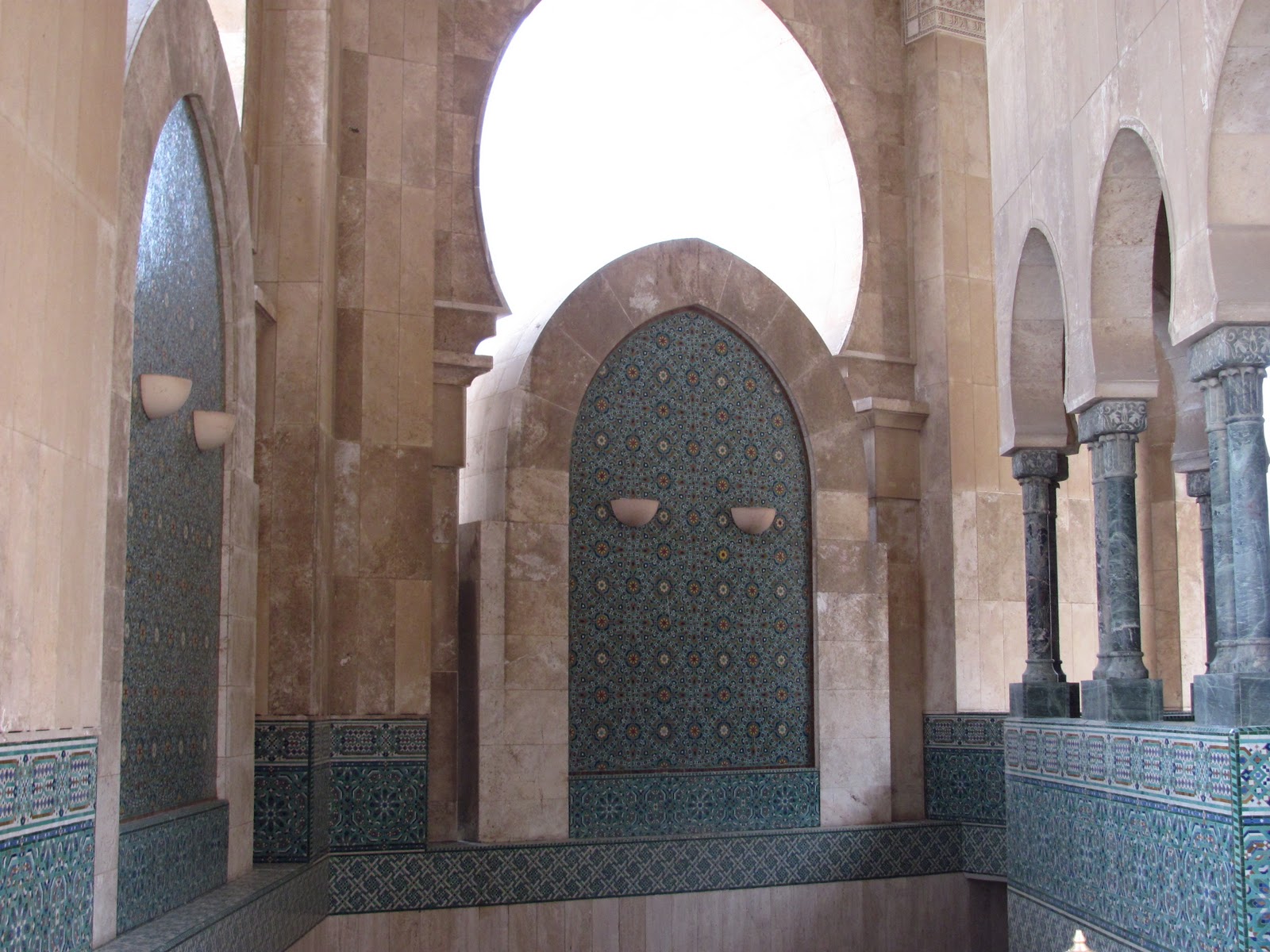
Hassan II Mosque!


View from the Mosque Pavillion


Rick's Cafe! They play the movie here of course. Mostly for tourists.